filipekMusikShoot

filipekMusikShoot
Marcus Miller
Affichage des articles dont le libellé est extraits. Afficher tous les articles

mercredi 20 juillet 2011

Chick Corea's Playlist For A Reunion Interview


Tomorrow night, a reconstituted Return to Forever begins a summer tour of over three months across the U.S. and Europe. The band was a prime mover of jazz fusion in the 1970s, and after decades on hiatus, a new lineup is once again set to take the stage with old hits and new songs. (A "classic" version of the band toured in 2008.)

Keyboardist Chick Corea founded Return to Forever in the early '70s. While it's known best for its role in defining jazz fusion, Corea says the project is really defined by its stylistic versatility, and its principal players. "For me, Return to Forever in its essence is my collaboration with [electric bassist] Stanley Clarke," he said. "'Cause Stanley's been there with me through all the iterations of Return to Forever, and I don't think I would ever call a band Return to Forever without Stanley being there."

I recently asked Corea to select a five-song playlist for our Take Five series which would help illustrate the history of Return to Forever. We spoke about his picks over the phone — the slightly edited transcript of which follows.


1. Miles Davis, "Concierto De Aranjuez,"

from

Sketches Of Spain


(arranged by Gil Evans)


Patrick Jarenwattananon: The first thing you picked out is the piece from Miles Davis' Sketches of Spain, the "Concierto de Aranjuez." ... What do you remember about hearing this for the first time?

Chick Corea: Well ... it was on the heels of some other recordings that began with a recording called Miles Ahead, and that was the first studio recording that Miles did with Gil Evans' arrangements and the orchestra. And it was such a beautiful piece of music, and it was such a new and successful form too. It wasn't exactly a symphony orchestra, no strings, but very beautiful writing with Miles as a lyrical soloist. And it made a great impression on me as a composer, as an arranger. Of course, I'd been following and learning and loving Miles'. Everything that he did since I first came across him playing with Charlie Parker in 1947 when I was really a tot. But anyway, I thought, if I was to chose one thing from Miles that might be a nice one to play, which has Miles' great lyrical performance together with his orchestral concept, with the great Gil Evans. And plus, Miles is also where myself and Stanley [Clarke] and [drummer] Lenny White and most of the guys in Return to Forever draw their inspiration from.

PJ: Of course, you worked with Miles later on in your life. What do you remember listening to this as — I guess you must have been a teenager then? What was this impact on you? And especially with regards to the whole Spanish vibe to this recording — I know you've drawn on the music of Spain and of Latin and Iberian jazz in general.

CC: Yeah. Well, it just brought together a lot of strings of interest for me at the time because I was already really interested in working with the New York Latin musicians. In fact my first really good gig when I got to New York after high school was with Mongo Santamaria's band. We played Birdland a couple of times. And Birdland at that time on 52nd Street was a couple of bars down from the Palladium. And so on breaks from my gig with Mongo, I used to run over to the Palladium and hear Tito Puente's band, and Machito's band, and Eddie Palmieri's band. That was some hot inspiration for me. It was a great compliment to the more serious jazz that I was into with Miles and Ornette Coleman and Coltrane and so forth. So when Miles came with "Concierto de Aranjuez," it brought together both of those worlds actually. And also introduced me to another strain of Spanish music which was the actual Spanish classical music. 'Cause the great [composer Joaquín] Rodrigo was the one that composed the theme for Aranjuez.


2. John Coltrane, "Pt. 2, Resolution" from A Love Supreme


PJ: The next tune you've picked is the second movement of A Love Supreme. Classic John Coltrane recording. And as I'm looking at this list I'm sort of wondering why you picked it.

CC: Well, it's for very similar reasons why I picked the Miles piece. Which is because John Coltrane is ... a major influence and inspiration to Stanley [Clarke] and myself, and Lenny [White] too. And to us, when we listened to our own music or when we listened to Return to Forever, or when we play — when you have a mentor and a musical hero that has that much sway, and that much inspiration for you, it's something that never leaves your life, and it works its way into everything that you do. So I thought if we were making a list, I thought rather than play all Return to Forever music, I'd give the listeners an idea of where we come from.

PJ: What about it do you think that you've adopted into Return to Forever, or even any of your other work. I mean, what about this particular recording?

CC: That's really hard to put into words. It's hard to be logical about it. It's an inspiration of freedom, and freedom of expression, and the courage to try new things, and to delve into music, and to try and bring something that's real deep inside that you could say is your own very personal case in music or in art or in life, and try to bring that in some way to people who all have other kind of tastes and different tastes. And so you have to reach a communication point. I sometimes think to myself that if I were to play the music that only is within the relm of my personal tastes, probably no one would want to listen to it! But I do care about trying to get the things that I love across to people. And I think that Coltrane's music and Miles' music too have that expression of freedom that we all love.

PJ: Did you ever know Coltrane at all?

CC: Unfortunately, I was so shy when I went and was next to him in clubs. I went to hear him play a lot in the '60s in New York, and night after night listening to the great band. And I was just so shy, I never walked up to him and said how much I liked it.


Chick Corea performs in Melbourne, Australia in February 2011. Corea and a new version of his band Return to Forever tour the U.S. and Europe this summer.
(Martin Philbey Photo)


3. Chick Corea and Return to Forever, "Spain," from Light as a Feather


PJ: The next tune you picked is from the second Return to Forever record and the first as Return to Forever, the band. Take me back to 1972 a little bit. You've already been releasing records as a leader, you've worked with Miles Davis for a while now. You've worked in the band Circle. What prompted you to start this new project? What were you listening to at the time? What was the genesis of Return to Forever?

CC: Well, it was just a passion to want to pull together some aspects of music that I loved — that I felt I wanted to express. Like when I worked with Miles for the two-and-a-half years, and then with Dave Holland and Circle for like a year or two after that, I loved both of those experiences. I wouldn't trade them for anything. But what they lacked for me and what I wanted to delve into more was a groove music. A music that had a beat to it, that was in some way danceable and that you could feel and that had a sort of melodic-ness to it.

So that led me into writing. Actually I wrote some of the songs from the first record like "Sometime Ago" and "La Fiesta" — I wrote those songs while I was preforming with Circle. Actually Circle has some performances of "Sometime Ago." We used to play "Sometime Ago" with Circle. It was like a transition thing for me. So then when I came to New York and hooked up with Stanley, who we met playing with the Joe Henderson band. Stanley and I shared those kinds of tastes for groove and for melody, and for that kind of thing. And I also wanted to have a vocalist in my band. So all of those elements came together as we developed that first Return to Forever.

PJ: You've said before that you've wanted to communicate more with audiences in that music and I guess that's what you mean by having a groove?

CC: Absolutely! Sure! You put a beat to music, and people can understand it. I think it's a simple thing to observe. That a listener gets into a rhythmic rapport with a piece of music, and the message comes across a lot more fluently, it seems.

PJ: I'm wondering, a tune like "Spain" was so growing and eposodic, do you feel that the Sketches of Spain album or even just the Concierto had any influence on this piece?

CC: Well, not only an influence but it became a part of the piece. ... There's three movements to [Rodrigo's Concierto de Aranjuez]. And the second movement is the movement that's arranged into the Sketches of Spain. And it was the movement that, that melody that I began to experiment with. Out of my experimentation with that melody came the rest of the arrangement which became the song "Spain." So when we would perform it live, I would always play that theme, that Aranjuez theme as an introduction to "Spain," and they became locked together as a performance. I still do it, when people ask for "Spain" in concert I play [hums opening salvo of "Concierto de Aranjuez"] and people know what's coming up.


4. Return To Forever, "The Endless Night," from Musicmagic


PJ: The next tune you've picked is from, I guess, what is the last Return to Forever album, it's called Musicmagic and it's a tune called "The Endless Night." And listening to it, this is, what, five years after the first Return to Forever recordings. This band has changed a lot.

CC: Oh yeah, It was a brand new ensemble. It was like a whole new idea that Stanley and I had been thinking about. Both of us were becoming more and more interested in orchestration, and I had already made the recording, The Leprechaun, which was with strings and brass and so forth. So this was our attempt to put our compositions in an orchestral setting. I thought "The Endless Night" was a good choice because it not only has the orchestration in it so you can hear the band, but its got some nice little sections with Stanley and Gayle [Moran, Corea's wife] singing the melody together.

PJ: You know, what I hear when I listen to this tune is the sort of influence of progressive rock, if that was anything that you were listening to at the time — this very organized, heavily orchestrated, lush, long ...

CC: Yea. You know, I didn't until way later start to listen to bands like Yes and so forth who preformed that way. Emerson, Lake and Palmer and so forth made some great music. Actually even, you know who I'd put in that category also was the Beatles with their orchestrations and so forth. No, this kind of orchestration came more from the end of classical music I would say. Bach and Mozart and Debussy and Bartok kind of having a traffic incident with Sly and the Family Stone and the Mahavishnu Orchestra.


5. Mahavishnu Orchestra, "Smile of the Beyond," from Apocalyse


PJ: And so that brings us to Mahavishnu John McLaughlin. You picked a tune from the album Apocalypse — it's called "Smile of the Beyond."

CC: The reason why I put Mahavishnu in there and John especially — if we had had more tracks, I would have added something by Herbie Hancock, I would have added something by Weather Report to kind of see the way all of my friends, and what directions they were going with their writing in the '70s — but this is just one instance of where a bunch of forces come together that is on the line of what we're doing these days.

First of all, the producer of this recording is George Martin. And Gayle [Moran] is my wife — she's singing on this track — so she's told me many times what the experience of recording this track was, in the studio in London, with the London Philharmonic Orchestra and John McLaughlin. Now, in the John McLaughlin group was Jean-Luc Ponty at that time, who's now playing with us, and also Michael Narada Walden, who I just saw play with Jeff Beck the other night and he played the drums like a god. He was incredible. And also all of the things that Narada has done since playing drums with John McLaughlin, he went ahead and produced some of the best pop music ever. Plus my wife Gayle who has this georgeous voice.

And all of these elements came together on this piece called "Smile of the Beyond." It's got this georgeous beautiful composition of John's, one of my favorites of John McLaughlin's melodies. Of course, John and the Mahavishnu orchestra particularly were a real catalyst to Stanley and I back in the '70s in making our transition from Return to Forever I to Return to Forever II, which was the electric version of Return to Forever. I know it was [for] me, John's influence and the way he took the electric guitar and was the first time I had ever heard it played that way, and it was very inspiring. So I thought it was apropos we put a track of Mahavishnu in here.


PJ: Return to Forever was together for a fairly brief time, say, five or so years. What lead to the breakup to that band at the time, and why are you guys getting back together?

CC: I think we had taken it to a point where everyone's solo ideas were just at the forefronts of everyone's minds. Stanley had already made several of his own records, Lenny and Al [di Meola] as well. And me, I was making Leprechaun and My Spanish Heart, and we had more musical terrain that we wanted to experiment with. At that time anyway, the musical terrain of Return to Forever seemed limiting to us, to me anyway. It seemed like it didn't have enough variety in it for me to explore the things that I wanted to do. So we went ahead and did all of those things that we wanted to do. It just took a few decades to get back together again.


rtf4

The latest reincarnation of Return to Forever, which calls itself Return to Forever IV. L-R: Jean-Luc Ponty, Lenny White, Chick Corea, Stanley Clarke, Frank Gambale.


PJ: Why bring it back now? What inspired you to put it all together?

CC: A lot of the prompting actually came from the consistency of fans out on the roads, mentioning and requesting Return to Forever. When I go out and play, when Stanley goes out and plays, when Lenny goes out and plays, the band's name comes up a lot, and in that way it keeps it fresh in our minds. And we talk about it when we speak and so forth, and it helps us think about it and review it and see that this possibly could bring some pleasure to the fans of Return to Forever ... That was a major reason actually for bringing Return to Forever back together again.

And then that framework, of course, that we planned with one another, we could create practically anything. We're going to play some of the "hits" from all of the Return to Forever repertoire, as well as from our individual solo repetoires. For instance, we're doing "School Days," which is Stanley's tune. We're writing new music and were going to play some acoustic songs on the tour as well, so it should be a great pleasure.







mardi 12 avril 2011

Spaces Revisited de 1997 Larry Coryell,Richard Bona,Billy Cobham :"Morning Of The Carnival" & Richard Bona


FILIPEK FOTO SHOOT Bordeaux, 16 mars 2010


Et Richard Bona Chez F.Teddei la seule émission buvable & ouverte.

Richard l'Ange de la Basse et du Son de ses origines.


jeudi 17 février 2011

. Miles Davis : "Someday My Prince Will Come" & Kind of Blue .


Miles Hulton Archives


"Someday My Prince Will Come," from the 1937 animated film Snow White and the Seven Dwarfs, has been recorded by many, many great jazz artists.
(It can also be found on the Brubeck recording above.)


One of the best-known and loved versions is this one, performed by the all-star cast of
Miles Davis on trumpet, John Coltrane and Hank Mobley on tenor sax, Wynton Kelly on piano, Paul Chambers on bass and Jimmy Cobb on drums.

The musicians maintain some of the wistful feeling Snow White sang in the film version of the song, but the group's instrumental version exudes more depth and complexity.


Miles Davis 1959 Don Hunstein


Miles Davis Kind Of Blue


"E.S.P." is the title track from the eponymous 1965 LP.

The record is the first studio album to feature Miles Davis' so-called "second" great quintet, pairing the great trumpeter with the advanced harmonic and rhythmic ideas of a younger generation of musicians.

Featured are Wayne Shorter (tenor sax), Herbie Hancock (piano), Ron Carter (bass) and Tony Williams (drums).


Round Midnight


jeudi 10 février 2011

. Charles-Eric Charrier : The French multi-instrumentalist layers Jazz, Noise and Melody to make an intriguing Parfait of Sound .


Charles-Eric Charrier is a multi-instrumentalist who lives and works in Nantes, France, and says he's recorded nearly two dozen albums.

For his latest work, Silver, Charrier played most of what's on the record:

Bass, piano, trumpet, metallophone, charango and what he calls "breath." Longtime collaborators Ronan Benoit and Cyril Secq also sat in on the sessions: Benoit covered percussion while Secq handled guitar, organic synthesizer and additional metallophone and charango.

As far as how long the three have worked together, Charrier says, "[I] don't remember well, because I've got this fabulous impression to [have] known them since a very long time, maybe before Jurassic."

Perhaps that's why the album's recording process wrapped in just four sessions — that's one week total.


That sort of obsessive commitment and well-rounded instrumentation is what makes Silver resound.

It starts as a faint glow, growing in brightness with each sparse snare-drum strike.

Slow, Nancy Sinatra-esque guitar cuts through the psychedelic, seductive rhythms of the opening track.

Unfathomably, those same slap-backed strings assimilate into the wall of emotive sound.

Classic brush-drumming is paired with ambient samples in the following track, "12 From," catapulting the sound into space-jazz territory.

Charrier says he listened to a lot of African and Arabian records during the Silver sessions.

Those influences are evidenced in the subtle warbling of "9 Moving," with its strings rising wildly before coiling into an exhausted heap.


Listen "21 Echoes Short "


mercredi 2 février 2011

. Eric Clapton Part.1 : Sex, Drugs and Rock 'N' Roll: Clapton After 'Cocaine'


14th January 1973: British blues-rock singer and guitarist, Eric Clapton, in concert at the Rainbow Rooms. (Photo by Express/Express/Getty Images)


Eric Clapton released a version of the J.J. Cale song "Cocaine." At the time, Clapton was consuming copious amounts of cocaine — and alcohol — and had only recently kicked a heroin habit.

Now 62, the legendary guitarist looks back and wonders how he survived his decades of drug and alcohol addiction. Sober for 20 years, Clapton is the father of three young daughters, ages 6, 4 and 2.

Clapton writes about his many years of addiction in his new autobiography, Clapton. He calculates that he was spending the current equivalent of 8,000 pounds — about $16,000 — a week on heroin.


Drug-Filled Days, Nights


"Financially, it was ridiculous," Clapton tells Melissa Block in the second of a two-part interview.

"The thing about that kind of addiction that's pretty funny, on reflection, is that I always thought, 'I'm handling this. I can handle it. I can stop anytime. I just don't want to stop right now,'" he says.

During the three-year period that he was most deeply involved with heroin, Clapton says he stayed home a lot and did not perform live very often.

Later, when he had overcome his heroin addiction but was still battling alcohol abuse, he once performed lying down on the stage.

"It didn't seem that outlandish to me, and in fact, probably was all I was capable of. It was either that or just laying down somewhere else. The fact that I was laying down on stage means at least I showed up," Clapton says.

He characterizes the mid-1970s as a time that was "extremely casual and crazy … when anything was possible."

"I think in the book I did refer to the fact that there were people who were moving through that period with respect and dignity, and I just didn't run into them that often," he continues.


Music as Salvation


Even during these dark days, the music kept him going.

"The presence of music in my life has always been the salvation element of it. Not necessarily the playing, as much as just being conscious of it, listening to it, has kept me moving," Clapton says.

Clapton says he doesn't think his music suffered that much as a result of his addiction — he thinks if it had, it would have brought him to recovery earlier — and he expresses mixed emotions about his past.

"I don't know that I can honestly regret any of it safely, because it's brought me to where I am. My life would not be the same, and I would not have what I have today, were [it not] for the fact that I went through all this stuff," Clapton says.

"But I suppose if I do have any regrets, it is that musically I lost something there."


Life After Drugs


Sobriety brought its own challenges.

Making music without drugs and alcohol was very difficult initially — everything sounded so loud and rough to him — as was sex.

"It was funny because both [of] those things were things that I took for granted. And yet, without alcohol, both of them became very, very difficult and unmanageable," Clapton says.

He says that his earliest experiences with women were always fueled by alcohol.

"And so when you took it away, I just didn't know what to do and actually was, for quite a while, physically impotent. I was terrified. I would be paralyzed with fear. And I think, musically, it was the same," he says.

Despite his age, Clapton says he plans to continue touring ("It's something I will ways need"), although the days of huge tours are probably behind him.

"I don't think those big world tours are possible for me anymore, nor are they desirable, because there's somewhere else I'd rather be — with my kids and my wife. The home life has a lot of power for me now, and it's where I get most of my satisfaction," Clapton says.


. Eric Clapton : Life Part. 2 : Eric Clapton Looks Back at His Blues Roots .


Eric Clapton 1967 NYC Band Cream


Eric Clapton has been reinventing himself musically for more than 40 years. But the strong pulse of the blues has powered his guitar playing since the beginning: from the Yardbirds when he was 18, through his stints with John Mayall and the Bluesbreakers, Cream, and Derek and the Dominoes, to today.

Now 62, the legendary guitarist is the author of a new autobiography, Clapton.

In the first of a two-part interview, Clapton talks to Melissa Block about his musical influences as a young man.


'Uncle Mac' and the Blues


His first guitar, which he got when he was 13, was a steel-string Hoyer made in Germany. It was about as big as he was, Clapton recalls.

"It was a very cheap guitar. And most cheap guitars, as anyone will tell you who tries to play a cheap guitar … they hurt to play," Clapton tells Block.

"It sounded nice, but it was just such hard work, I gave up. So I started when I was 13 and gave up when I was 13 and a half," he says.

Clapton's introduction to the blues — the music that would forever influence his own work — came from an unlikely source: a children's radio show in the 1950s and '60s hosted by "Uncle Mac" (aka Derek McCulloch).

The show's usual fare was novelty children's music, such as "How Much Is That Doggie in the Window?"

But every now and then, Clapton says, Uncle Mac would slip in some blues.

"I don't know what this guy was on; I can't imagine how it would get snuck in, whether it was his taste or someone else's, his wife, who knows?" Clapton says.


I Got What They Were Trying to Do'


Clapton even remembers the first blues song he heard on the show: "Whoopin' the Blues" (full song audio) by harmonica player Sonny Terry and singer and guitarist Brownie McGhee.

"That's where it started for me," he says.

"It got to me on a level that nothing else did. I got what they were trying to do," Clapton says.

"I think the purity of what they were trying to do undercut everything else that you could hear on the radio. Aside from great classical music or great opera, there was a seriousness about it that none of this other music had."


Listening to, Learning from the Greats


Other guitarists that Clapton listened to — and learned from — in those early years include Big Bill Broonzy and Muddy Waters.

Broonzy was "just an extremely good technician" and a "great player."

As he listens to a recording of Broonzy's "Hey Hey" (full song audio), Clapton notes the audible sound of the guitarist's foot tapping.

"His rhythm — it's absolutely perfect," Clapton marvels.


Waters' Playing Acted as 'Milestone'


Perhaps the blues guitarist who influenced Clapton the most is Muddy Waters.

"Muddy was there at a time when, really, the music was getting to me. I was really trying to grasp it and make something out of it," Clapton says.

Clapton says he would listen to a Waters' song such as "Honey Bee" (song clip audio) and try to emulate the guitar great's technique and the effect he created with his playing — in this instance, the chime-like sound of a bell.

"It was a hook to me. And I made this as a sort of milestone for me, for my learning capabilities," Clapton says.

"If I can get that, I'm one rung up the ladder. And I did, finally, manage to do it one day, and I thought, well, you know, I think I can probably do this."


A Mentor and Friend


The two guitarists played together later and became very close. In his book, Clapton describes Waters as "the father figure I never really had." Until his death in 1983, Waters was a part of Clapton's life.

Even so, Clapton says he was not comfortable enough — and perhaps too proud — to ask Waters technical questions about his playing.

"I wish I had," he says now.

But there was more than just professional pride at work.

"When I got to know Muddy, unfortunately, my drinking career was in full sway," Clapton says.

"He liked to drink, too, he wasn't really down on it or anything, but I was definitely not really there as much as I wish I had been."


Clapton Eric Norman Watson


dimanche 2 janvier 2011

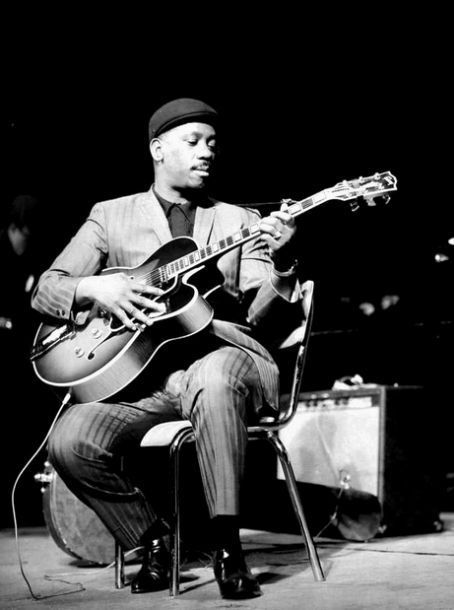
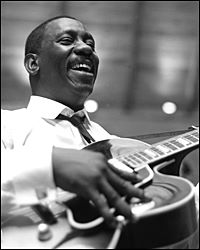
. Wes Montgomery .


The jazz guitar of Wes Montgomery, deemed "the biggest, warmest, fattest sound on record," still reverberates today, nearly forty years after his death.

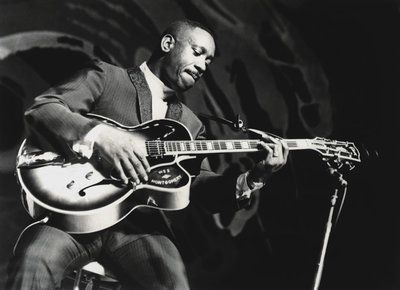
The most influential, widely admired jazz guitarist since Charlie Christian's heyday, Wes re-invented the instrument with his thumb-plucking technique, his innovative approach to playing octaves, and his inventive, masterful execution of complex lines. In the short span of a 9 year recording career as a leader, his name became synonymous with the jazz guitar.

Despite the sophistication of his technique, Wes had no formal musical education.

Born on March 6th, 1923 in Indianapolis, Wes grew up making music with his brothers, several of whom also became professional musicians.

Electric bass guitarist Monk Montgomery recalls buying his brother his first guitar, a four-string tenor, on which 12-year-old Wes demonstrated immediate proficiency.

Wes learned by jamming with his brothers and by emulating Charlie Christian, who inspired Wes to pursue jazz guitar professionally.


Wes Montgomery's first record as a leader was the result of two trio sessions in October 1959 (with Mel Rhyne, organ and Paul Parker, drums).

Among the highlights are this Jerome Kern number, where a relaxed groove masks the subtle intricacy of Montgomery's solo lines and the supple warmth of his tone.


After his first big-time gig, touring with Lionel Hampton's band, Wes returned home to Indianapolis, where he worked days to support his growing family and played guitar in local bars all night.

Meanwhile, Wes' brothers were enjoying some degree of success with their group, the Mastersounds, and they invited Wes to record with them to gain the gifted guitarist greater exposure.

Sure enough, word spread and soon musicians like Cannonball and Nat Adderley were flocking to the Missile Room to witness the new sensation.

Riverside Records producer Orin Keepnews was blown away by Wes' virtuosity and signed him on for 25 sessions.

Wes' second album, The Incredible Jazz Guitar of Wes Montgomery, earned him Downbeat magazine's "New Star" award in 1960.

Wes' lush, inimitable sound was a product of his unusual stylistic approach.

Guitarist Lee Ritenour explains how Wes played with his thumb as opposed to a pick, freeing himself from rhythmic constraints and typical phrasing.

According to Wes, thumb-plucking and his technique of "playing two notes at the same time an octave apart" were both accidental revelations.

While Wes was not the only guitarist to utilize the octave approach, he did so with incomparable "freedom and fluidity," and the technique "became one of his trademarks."


When Riverside Records folded, the Verve label took Wes Montgomery onto their roster.

It proved a wise move: some of his best performances on record were Verve releases.

This 1964 big band rendition of the Juan Tizol/Duke Ellington standard features Montgomery's resonant chords particularly well, not to mention his facility and energy at fast tempos.


When Riverside Records went bankrupt, Creed Taylor of Verve Records signed the acclaimed guitarist, steering his career in a different direction.

Although Wes recorded a few straight jazz albums with Verve, including his triumphant Smokin' at the Half Note, Taylor sought to bring Wes' music to a broader audience, convincing him to cover the R&B hit, "Goin' Out of My Head."

The album, which earned Wes a Grammy Award, was his ticket to "crossing over" and made a name for him on the pop scene, enabling him to support his wife and seven children.


To the chagrin of jazz purists, Wes did not record another jazz album after 1965.

However, in concert, as critic Gary Giddins attests, Wes continued to improvise stunning solos until his death of a heart attack in 1968.

In a remarkably brief time frame, Wes Montgomery, a kind, modest man and a magnificent musician, left a legacy of enormous distinction to the jazz community


Wes Montgomery had his best-selling records with what were, by his own description, pop tunes.
Encouraged by producer Creed Taylor, he waxed several such discs for Verve and A&M in the mid-late 1960s.

However, he always maintained a jazz sensibility to his solos, as evidenced in this much-anthologized 1965 recording (featuring Oliver Nelson's orchestra).


Watch 'Jazz Icons' Trailer :


This DVD chronicles several of Montgomery's live 1965 performances in Europe. Note: QuickTime required


dimanche 21 novembre 2010

. JACO PASTORIUS LESSONS . Modern Electric Bass . 1 à 5 .


. JACO LESSON . 1 .


. JACO LESSON . 2 .


. JACO LESSON . 3 .


. JACO LESSON . 4 .


. JACO LESSON . 5 .


. JACO PASTORIUS .


JACO PASTORIUS SITE


. JACO PASTORIUS LESSONS . Modern Electric Bass . 6 à 10 .


. JACO LESSON . 6 .


. JACO LESSON . 7 .


. JACO LESSON . 8 .


. JACO LESSON . 9 .


. JACO LESSON . 10 .


Idoles

Richard Bona (5) ChristianMcBride (4) David Lynch (4) Miles Davis (4) Victor Wooten (4) Chick Corea (3) Dennis Chambers (3) Eric CLAPTON (3) Jaco PASTORIUS LIFE (3) "Round Midnight" (2) Brad Meldhau (2) Hiromi (2) Jaco Pastorius (2) Live in Paris Richard Bona Mike stern (2) Marcus Miller (2) Mike Stern (2) Richard Bona Photo Bordeaux Live (2) Wes Montgomery (2) "Someday My Prince Will Come" Miles Davis (1) . Marcus Miller "Blast" ... Ce Soir... ou jamais (1) Antonio Sanchez (1) Atoll in 80 (1) Blue in Green (1) Cabasse Mercure MC40 (1) Charles MINGUS (1) Chick Corea Roy Haynes Kenny Garrett Christian McBride North Sea Jazz Festival 2010 (1) Christian Mc Bride Three Times Presentation (1) Christian McBride (1) Christian McBride May 27 2010 detroit festival (1) Concert STANLEY CLARKE LENY WHITE CHICK COREA at the Monterey Jazz Festival 2009 (1) Eric Clapton Life 1 (1) Eric Clapton Life 2 (1) Esperanza Spalding (1) For Senor Blues: A Horace Silver Tribute concert 20 juin 2008 (1) Hank Jones Trio On JazzSet (1) Haute Fidélité (1) Herbie Hancock (1) Herbie HancockNewport Jazz Festival (1) Herman Leonard (1) Hiromi's Sonic Bloom:Newport Jazz Festival 2009 (1) Horace Silver (1) JACO PASTORIUS LESSONS . Modern Electric Bass . 1 à 5 (1) JACO PASTORIUS LESSONS . Modern Electric Bass . 6 à 10 . (1) Joseph ZAWINUL (1) Kenny Garrett (1) Kind of Blue (1) Lenny White (1) Live Moment from the 2008 Basel Jazz Festival (1) Marcello Guiliani (1) Marcus Miller North Sea Jazz 2010 (1) Marcus Miller Photography (1) Pat Metheny (1) Pat Metheny Trio Marciac 2003 (1) Roy Hargrove (1) Roy Hargrove Quintet (1) Roy Hargrove Quintet : Live At The Village Vanguard (1) Roy Haynes Drums (1) Sonny Rollins (1) Triangle Esprit (1) Tutu Revisisted by Marcus Miller (1) Zawinul Medley by RICHARD BONA (1)

Rechercher dans ce blog

Artistes

Concerts

Tiny Desk Concert (6) Richard Bona (5) ChristianMcBride (4) Victor Wooten (4) Chick Corea (3) Eric CLAPTON (3) Stanley Clarke (3) Hiromi (2) Live in Paris Richard Bona Mike stern (2) Marcus Miller (2) Mary Lou Williams (2) Wes Montgomery (2) Ameen Saleem (1) Bela Fleck (1) Ben Allison (1) Ben Allison In Concert : Newport Jazz Festival 2011 (1) Bill Callahan (1) Booker T. Jones (1) Chick Corea Roy Haynes Kenny Garrett Christian McBride North Sea Jazz Festival 2010 (1) Christian Mc Bride Three Times Presentation (1) Christian McBride May 27 2010 detroit festival (1) Concert North Sea Jazz 2010 (1) Concert STANLEY CLARKE LENY WHITE CHICK COREA at the Monterey Jazz Festival 2009 (1) Dave Holland (1) David Russell Classic (1) Edgar Meyer (1) Elvis Costello (1) Eric Clapton Life 1 (1) Eric Clapton Life 2 (1) Esperanza Spalding (1) For Senor Blues: A Horace Silver Tribute concert 20 juin 2008 (1) Hank Jones Trio On JazzSet (1) Herbie Hancock (1) Herbie HancockNewport Jazz Festival (1) Hiromi's Sonic Bloom:Newport Jazz Festival 2009 (1) Joseph ZAWINUL (1) Kenny Garrett (1) Lionel Loueke (1) Live Moment from the 2008 Basel Jazz Festival (1) Marcus Miller North Sea Jazz 2010 (1) Mary Lou Williams Originally recorded Sept. 21 1978 at the University of Michigan and March 10 1976 at the University of Wisconsin in Madison. (1) Pat Metheny Trio Marciac 2003 (1) Rafael Saadiq (1) Roy Hargrove (1) Roy Hargrove Quintet (1) Roy Hargrove Quintet : Live At The Village Vanguard (1) Roy Haynes Drums (1) The Rosetta Trio perform live on WBGO's (1) Tutu Revisisted by Marcus Miller (1) Zakir Hussain (1) Zawinul Medley by RICHARD BONA (1)

Classic Jazz

extraits (30) bass (15) Tiny Desk Concert (6) Richard Bona (5) ChristianMcBride (4) Miles Davis (4) Victor Wooten (4) Chick Corea (3) Dennis Chambers (3) Eric CLAPTON (3) Jaco PASTORIUS LIFE (3) Stanley Clarke (3) history (3) "Round Midnight" (2) Allen Toussaint (2) Brad Meldhau (2) Chris Potter (2) Hiromi (2) Jaco Pastorius (2) Marcus Miller (2) Mary Lou Williams (2) Mike Stern (2) Rosetta Trio (2) Stefan Crump (2) Wes Montgomery (2) "Someday My Prince Will Come" Miles Davis (1) Ben Allison (1) Ben Allison In Concert : Newport Jazz Festival 2011 (1) Blue in Green (1) Blues Bluesman (1) Booker T. Jones (1) Brad Meldhau Highway Rider (1) Charles MINGUS (1) Charles-Eric Charrier (1) Charlie Hunter (1) Chick Corea Roy Haynes Kenny Garrett Christian McBride North Sea Jazz Festival 2010 (1) Christian Mc Bride Three Times Presentation (1) Christian McBride May 27 2010 detroit festival (1) Concert North Sea Jazz 2010 (1) Concert STANLEY CLARKE LENY WHITE CHICK COREA at the Monterey Jazz Festival 2009 (1) Dave Holland (1) David Haynes (1) David Russell Classic (1) Edgar Meyer (1) Elvis Costello (1) Erik Truffaz Group (1) Esperanza Spalding (1) For Senor Blues: A Horace Silver Tribute concert 20 juin 2008 (1) Geri Allen (1) Hammond B3 Organ (1) Hank Jones Trio On JazzSet (1) Herbie Hancock (1) Horace Silver (1) JACO PASTORIUS LESSONS . Modern Electric Bass . 1 à 5 (1) JACO PASTORIUS LESSONS . Modern Electric Bass . 6 à 10 . (1) John Hammond (1) Joseph ZAWINUL (1) Kind of Blue (1) Lenny White (1) Lionel Loueke (1) Live Moment from the 2008 Basel Jazz Festival (1) Marcus Miller North Sea Jazz 2010 (1) Mary Lou Williams Originally recorded Sept. 21 1978 at the University of Michigan and March 10 1976 at the University of Wisconsin in Madison. (1) Medeski Scofield Martin Wood (1) Michel Camilio (1) Mose Allison New Album" The Way Of The World " (1) Mose Allison interview (1) Pat Metheny (1) Pat Metheny Trio Marciac 2003 (1) Roy Haynes Drums (1) Saxophone (1) Shirley Scott (1) Sonny Rollins (1) Sonya Kitchell (1) The Rosetta Trio perform live on WBGO's (1) Thelonious Monk (1) Tutu Revisisted by Marcus Miller (1) Zawinul Medley by RICHARD BONA (1) voice (1)

Filipek. Fourni par Blogger.